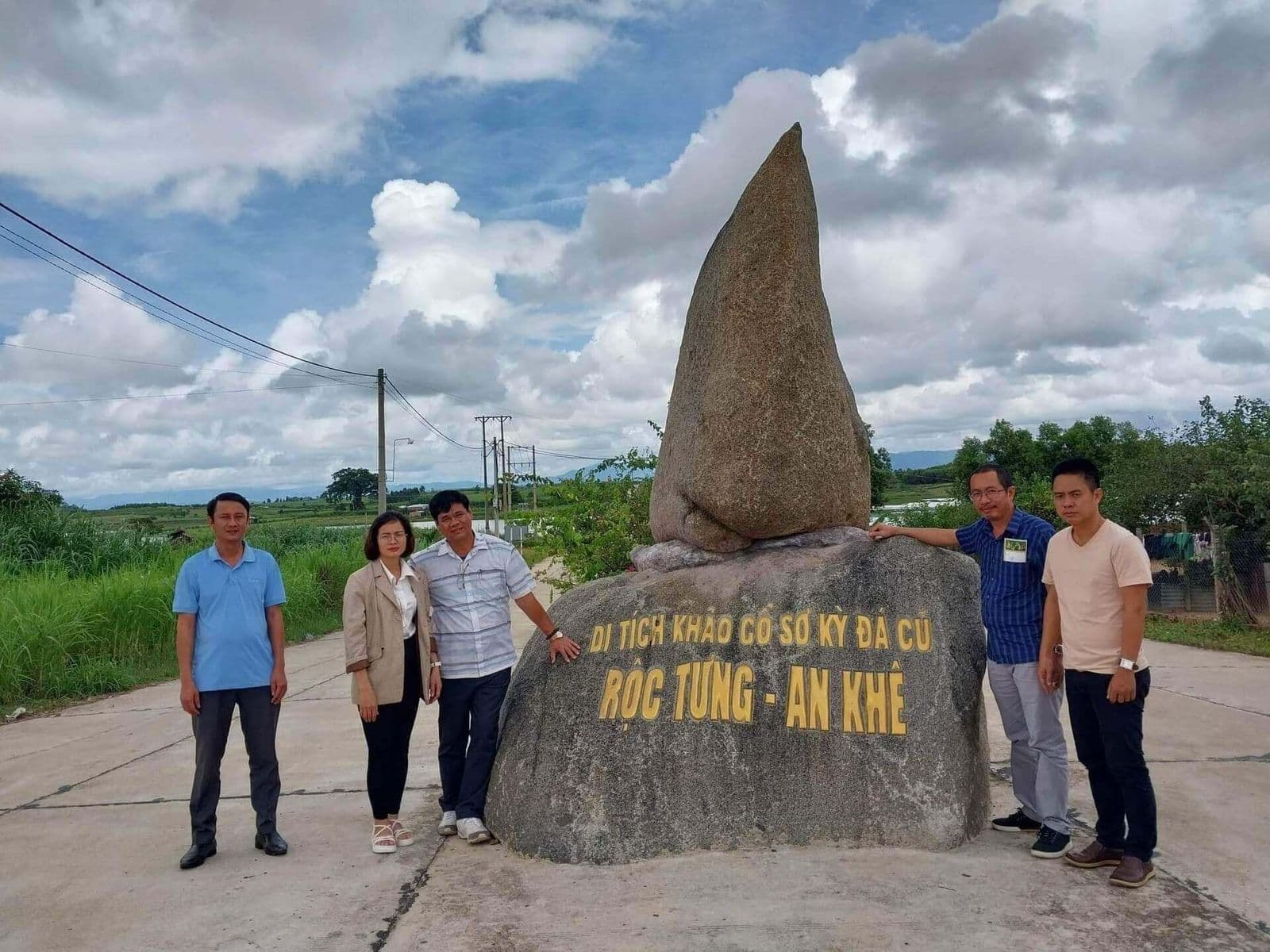
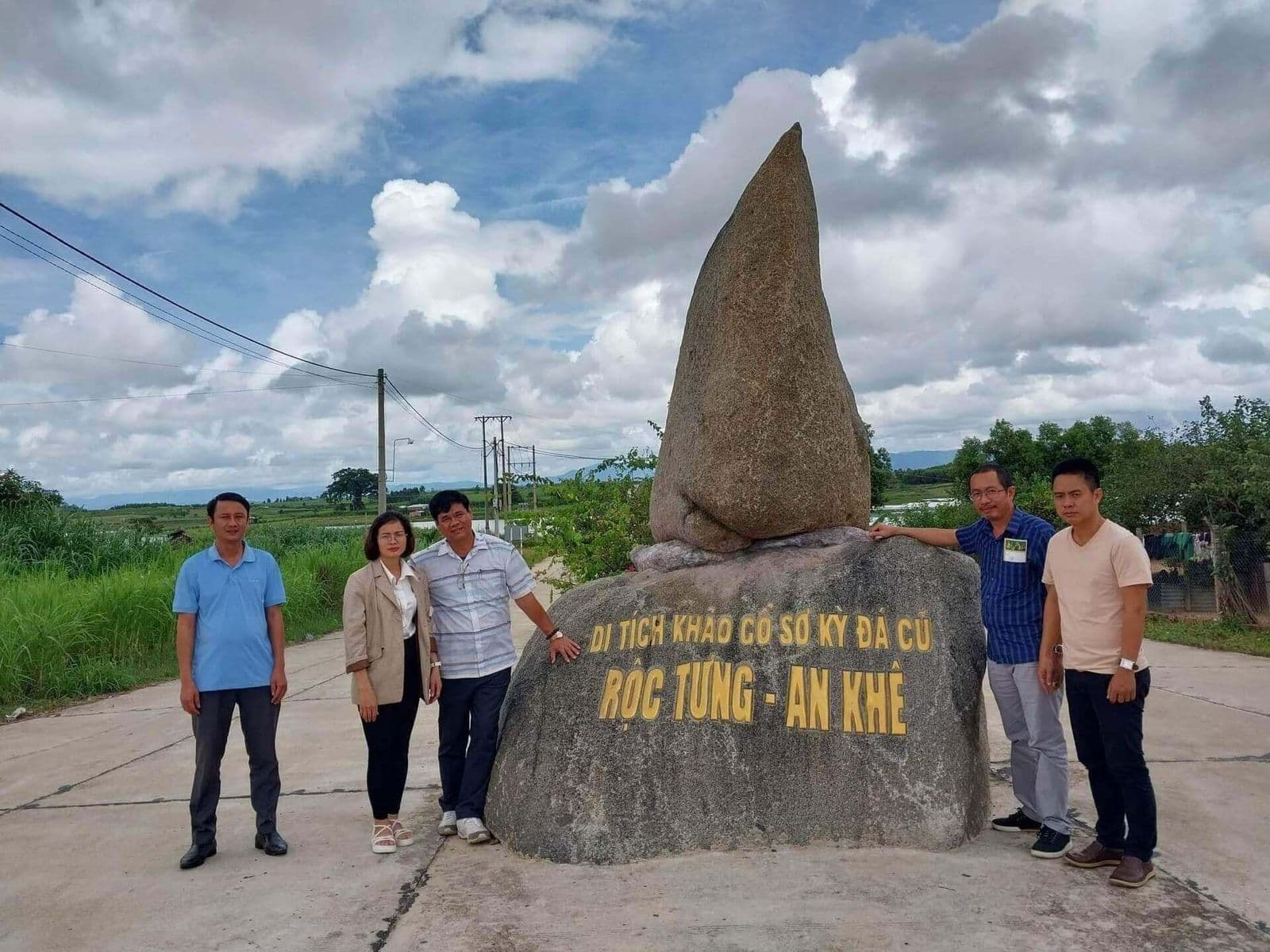
Located in An Khê town, Gia Lai province, the Rộc Tưng - Gò Đá Early Paleolithic relic complex comprises the Gò Đá site in An Bình ward and 12 Rộc Tưng sites in Xuân An commune, An Khê town, Gia Lai province. Of these, 4 sites have been excavated: Gò Đá, Rộc Tưng 1, Rộc Tưng 4 and Rộc Tưng 7. The rest have all been test-pitted and confirmed to belong to the same Rộc Tưng - Gò Đá complex.
Gò Đá is located in An Bình ward, An Khê town, Gia Lai province, at coordinates 13°58’19.2” N, 108°39’05.1” E, at an absolute elevation of 421.5 m. The site lies on the right bank of the Ba river, about 1.5 km from it, in an area of residual hills of the Ba river shaped by erosion and accumulation, dating to the Early Pleistocene (QI). The site was excavated twice (in 2015 and 2016), over a total area of 94 m², by the Gia Lai Department of Culture, Sports and Tourism in cooperation with the Vietnam Institute of Archaeology and the Novosibirsk Institute of Archaeology and Ethnography of the Russian Academy of Sciences.
The Gò Đá site has 1 cultural layer, formed of granite weathered in place, containing stone tools and meteorite fragments. Some common features: most are made of quartz and quartzite and are large; the predominant types are bifacial tools, triangular (trihedral) points, scrapers, chopping tools, flakes, hammerstones, pestles… crudely knapped with little retouching, with forms different from and older than the Early Paleolithic sites currently known in Vietnam such as Núi Đọ (Thanh Hóa) and Xuân Lộc (Đồng Nai). Gò Đá is a habitation and tool-making site of Early Paleolithic inhabitants at the stage of upright man (Homo erectus), in humanity's evolutionary line from there to modern man (Homo sapiens), and is evidence of humanity's first culture.
Rộc Tưng 1 is located in Xuân An commune, at coordinates 14°02’25.3” N, 108°40’82.2” E, at an absolute elevation of 556 m. It lies on the left bank of the Ba river, about 2.5 km from it, and was excavated 3 times (in 2016, 2017 and 2018). In 2016, pit 1 was excavated over an area of 48 m² (6 m x 8 m); in 2017, pit 2 was excavated over an area of 70 m² (10 m x 7 m), and was chosen for an on-site exhibition house when digging reached layer 1.2, at a depth of 0.8 m - 1.1 m (where the cultural layer was exposed); in 2018, 20 m² within the 70 m² of pit 2 were excavated to the depth of layer 2.2, and the remaining 50 m² are preserved under a roofed house.
Rộc Tưng 1 is a habitation and tool-making site, in which the habitation element is quite typical, shown on the surface of the cultural layer by several clusters of earth and stone, firmly bonded and raised above the surroundings, with a high concentration of quartz fragments, a few cores, flakes and knapped tools. As for the dating of Rộc Tưng 1, its geological structure is basically the same as Gò Đá, belonging to the Early Pleistocene; in terms of artifacts, the coexistence of bifacial tools, unifacial tools, triangular points, scrapers, choppers… bears Early Paleolithic characteristics. Rộc Tưng 1 is a habitation and tool-making site, in which the habitation element is quite typical, shown on the surface of the cultural layer by several clusters of earth and stone, firmly bonded and raised above the surroundings, with a high concentration of quartz fragments, a few cores, flakes and knapped tools.
Rộc Tưng 4 is located at coordinates 14°02’2.7” N and 108°40’35.7” E, at an elevation of 430 m, about 500 m from Rộc Tưng 1 and also on the left bank of the Ba river. The site was surveyed in 11/2015 and excavated in 2016, 2017 and 2018. The results of excavating 4 pits at the Rộc Tưng 4 site show that the pits have the same stratigraphic structure and artifact characteristics, reflecting habitation and tool-making.
The stone tool assemblage at the Rộc Tưng 4 locations is basically the same as at Rộc Tưng 1 and Gò Đá. Rộc Tưng 7 is located in Xuân An commune, An Khê town, at coordinates 14°01’452” N and 108°41’11.3” E, at an elevation of 438 m. The site was discovered in 2016 and excavated twice (in 2017 and 2018) over a total area of 40 m².
The excavations yielded a number of stone tools for chopping, points, scrapers, bifacial tools, cores and many flakes. Rộc Tưng 7 has characteristics, nature and dating similar to the sites excavated in the An Khê valley. The discovery and survey of the Rộc Tưng 7 site added to the list of Early Paleolithic sites currently known in the hilly area of the An Khê valley, adding further evidence of the presence of human communities of humanity's most ancient stage in Vietnam.
The Paleolithic archaeological sites in An Khê are all distributed on hills averaging 420 - 450 m above sea level, in the transition zone from the highlands to the coastal plain of Central Vietnam. The artifact assemblage in the An Khê Early Paleolithic sites is consistent and stable in material, type and manufacturing technique, bearing the common characteristics of an Early Paleolithic industry, named the An Khê industry. The An Khê industry is characterized by an assemblage of stone tools made from local river and stream pebbles, large in size, of hard, fine-grained stone, mainly quartz and quartzite.
The stone tools are crudely knapped, with typical types: bifacial tools (beface), hand axes (Handaxe), points (pick), triangular points and crude chopping tools (chopper). Of these, crude chopping tools are mainly distributed in Asia, bifacial tools and hand axes predominate in the Western Paleolithic, while points and triangular points are most distinct in the Early Paleolithic of the An Khê area. With these outstanding values, Rộc Tưng - Gò Đá, Gia Lai province, was ranked a national archaeological relic by the Minister of Culture, Sports and Tourism under Decision No. 3237/QĐ-BVHTTDL dated 04/11/2020.
On 29/12/2022, Prime Minister Phạm Minh Chính signed the certificate recognizing Rộc Tưng-Gò Đá in An Khê town, Gia Lai, as a "Special National Relic". Source: Department of Cultural Heritage.